Grade with Intention
After many years of teaching colour and post-production, one pattern kept repeating: students knew how to operate the tools but not why. These are the courses I built to fix that.
A pattern that kept repeating itself
After many years of teaching colour grading, video pipelines, and post-production to students and professionals of all ages and experience levels, one pattern kept repeating itself.
Students knew how to operate the tools. They could find the wheels, pull a curve, apply a LUT, build a basic node tree. Many of them had watched hours of tutorials, good ones, from experienced practitioners, and had genuinely learned from them. But the moment conditions changed, something broke. Different footage. A new camera. A delivery spec they had not seen before. A client who wanted something outside the template. And suddenly, the technique that had worked perfectly stopped working, and they had no way to reason their way through it.
They knew the how. They did not know the why. And that gap, small as it sounds, was the thing limiting every decision they made.
What I kept noticing was not laziness or lack of talent. It was a structural problem in how most video education is built. Tutorials optimise for visible results. Show someone a before and after, walk them through the steps to get there, and they leave feeling like they have learned something. Often they have. But they have learned to reproduce a result in a specific context, not to understand what they were actually doing to the image, or why it worked in those particular conditions, or what to do when those conditions change.
Over time, I started to think of this as tutorial damage, not a criticism of tutorials as a format, but a recognition that recipe-based learning becomes fragile the moment it meets professional reality. And I became convinced that what most working editors, colourists, filmmakers, and post-production students actually need is not another recipe. It is a way of thinking about the image.
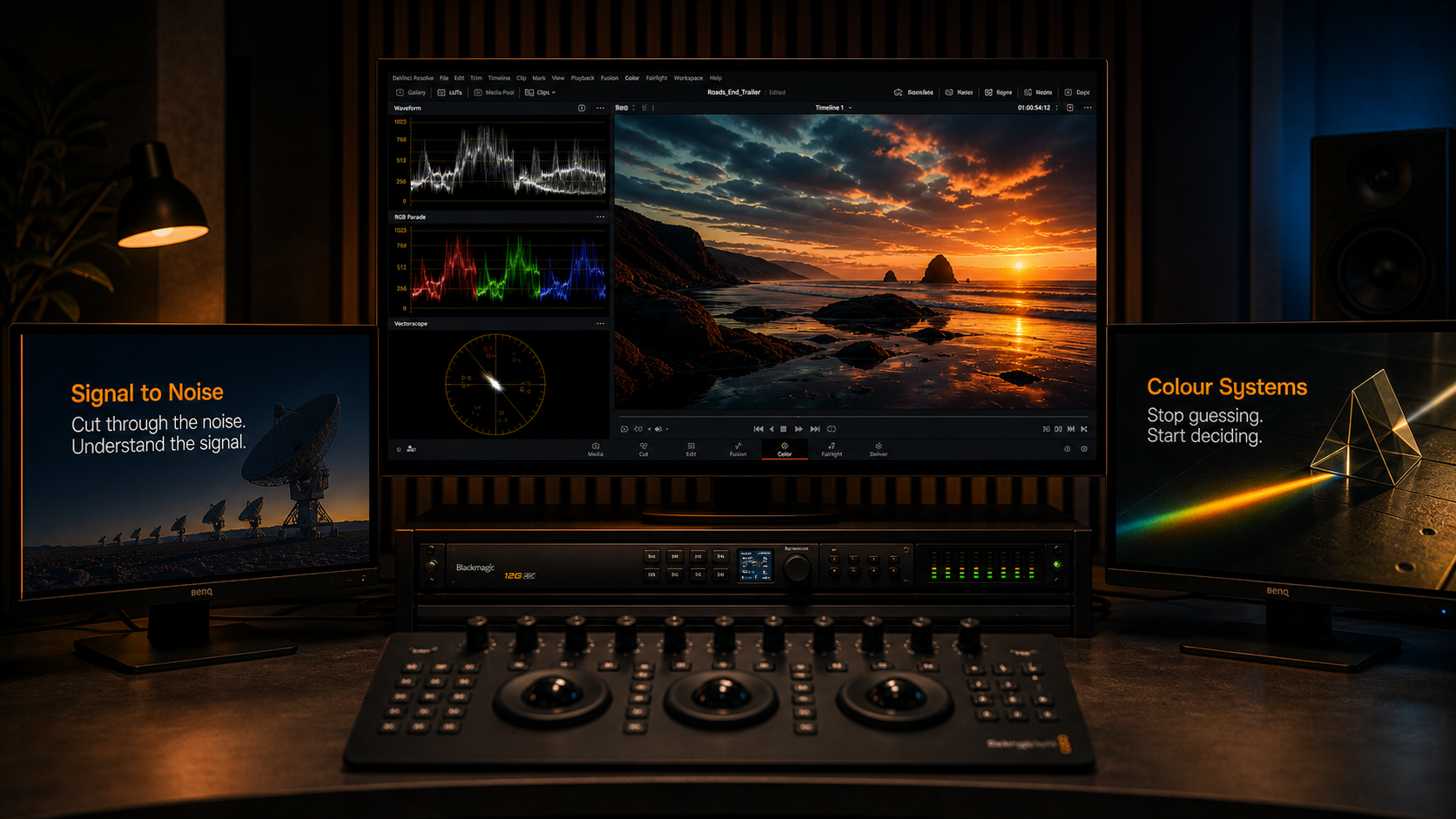
These two courses, Signal to Noise and Color Systems, are my attempt to build that.
The gap nobody talks about
There is a strange split in video education.
At one end, beginner tutorials: where the buttons are, how to make a basic grade, how to export a file. At the other end, deep engineering material: colour science papers, codec documentation, display standards, signal processing theory.
Both are valuable. But most working professionals and students live somewhere between them. They need enough theory to make better decisions, but translated into practical post-production language, not the language of academics or engineers, and not the oversimplification of a five-minute YouTube explainer either.
The missing piece is applied reasoning. The ability to look at an image and understand what it is doing, not just aesthetically, but technically. To know why log footage looks flat. Why clipping is not the same as brightness. Why two shots with similar RGB values can still feel completely mismatched. Why a LUT works on one camera and destroys another. Why a web export falls apart in gradients when the grade looked clean on your display.
These are not abstract questions. They show up on real timelines, with real clients, against real deadlines. And they cannot be answered with a recipe, because every situation is slightly different. They can only be answered by someone who understands the system well enough to reason through an unfamiliar problem.
That middle space, between “move this wheel” and “read the colour science paper”, is exactly where these courses are designed to operate.
This matters even more in the age of AI
I want to make this argument clearly, because it has become more urgent.
We are working in a moment where an increasing number of creative and technical decisions are being mediated by tools that do not explain themselves: AI-assisted grading, automated matching, smart isolation, denoisers, upscalers, LLM-generated scripts, generative image systems, and pipeline tools that can produce a plausible result without showing their reasoning.
I use these tools. They are genuinely useful when they help the work. That is not the concern.
The concern is this: in a world where the how can increasingly be handled by a machine, the why becomes the only thing that remains distinctly human. If you do not understand why a grade works, you cannot evaluate whether an AI-generated grade is actually good, or merely convincing. You cannot notice when an automated tool has quietly changed your colour metadata, normalised something that should not have been normalised, or produced a look that is coherent on screen but technically fragile for delivery.
A language model can suggest an ffmpeg command that looks correct but silently alters pixel format, colour metadata, or audio handling. A generative system can make an image feel polished while inventing texture, smoothing away useful detail, or anchoring a look to a statistical idea of “cinematic” that has nothing to do with your specific footage, format, or intent.
If you understand the pipeline, you can catch these things. You can prompt better, inspect results more critically, and decide whether the tool has helped the image or merely produced a confident surface.
The point is not to resist AI. The point is to remain literate enough to question it. And that literacy, the ability to read an image, understand its behaviour, and reason about what is actually happening to it, is precisely what recipe-based education does not build.
What each course actually covers
Signal to Noise is about the material reality of digital video. What is a codec actually doing to your image? What does bit depth protect, and when does it fail? Why is HDR a delivery condition rather than a guarantee of beautiful dynamic range? How do containers, colour space transforms, metadata, and broadcast specifications affect what a viewer finally sees?
The core question is: what is the signal, and what damages it?
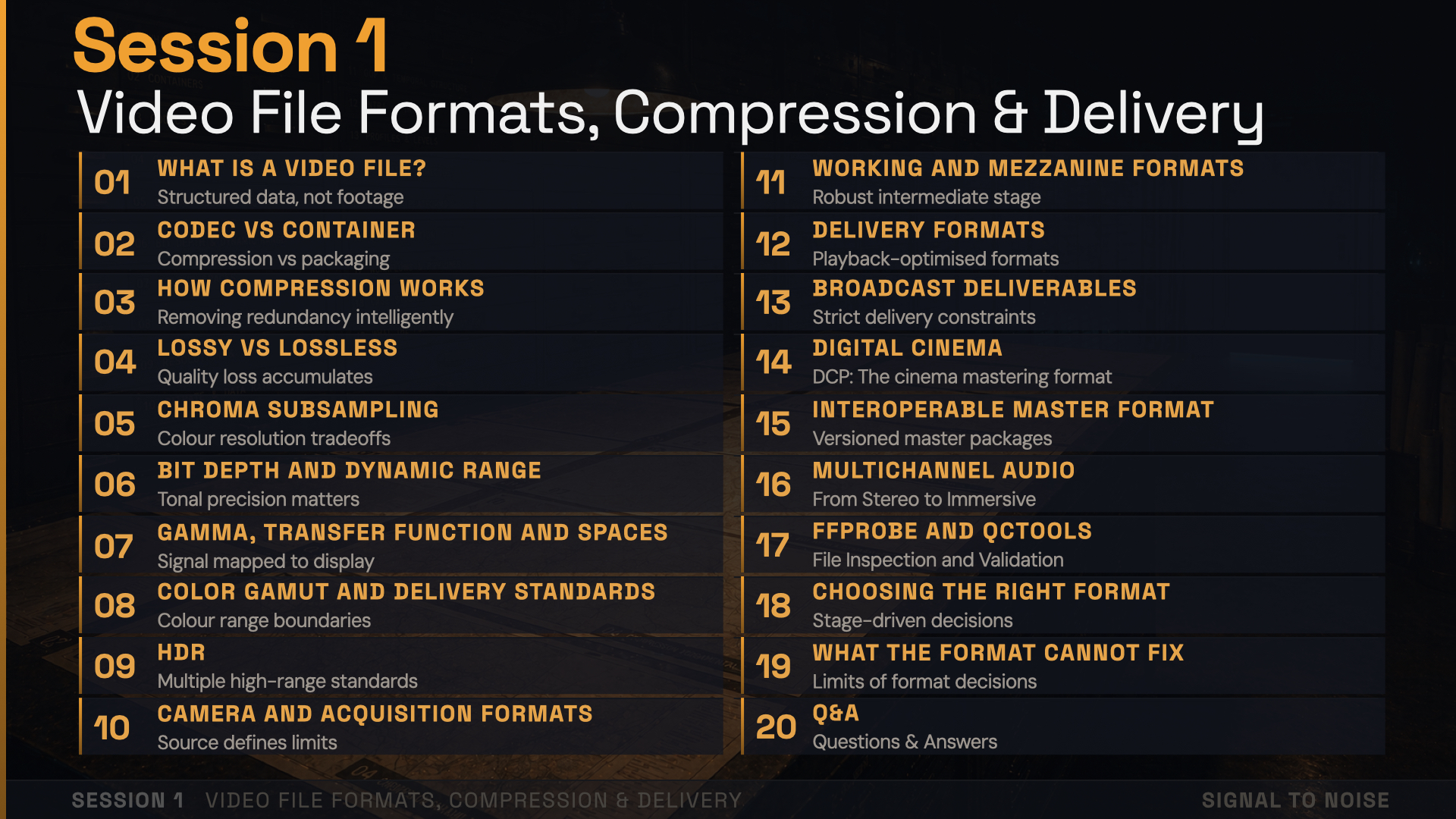
The first session covers video file formats, compression, and delivery, not as a glossary, but as a way of understanding how technical choices affect the image before it ever reaches a colour page.
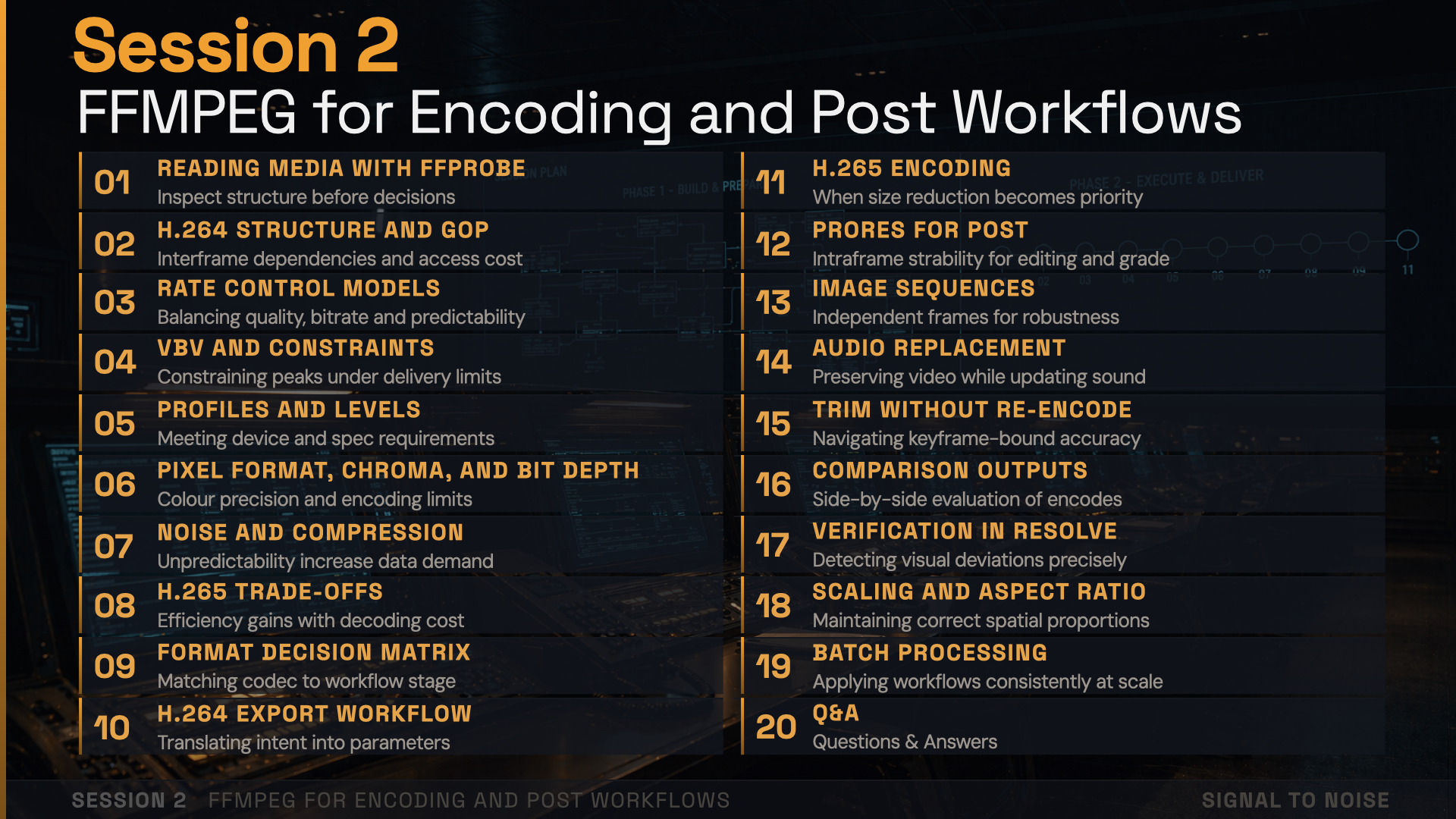
The second moves into ffmpeg and post-production workflows: not to memorise terminal commands, but to understand what each command is asking the file to do: inspect, copy, encode, preserve, compare, transform.
The course is deliberately hands-on. Students are not just told what codecs and containers are; they inspect files, compare exports, read metadata, and trace what changes as media moves between stages.
Color Systems is about what happens once you understand the signal. How should a node tree be organised? Where should colour space transforms live? When should a correction happen at clip level versus group pre-clip versus group post-clip? How do you match shots by reading evidence rather than chasing memory? When is a skin adjustment technical, and when is it aesthetic?
The core question is: once I understand the signal, how do I control colour with intention?
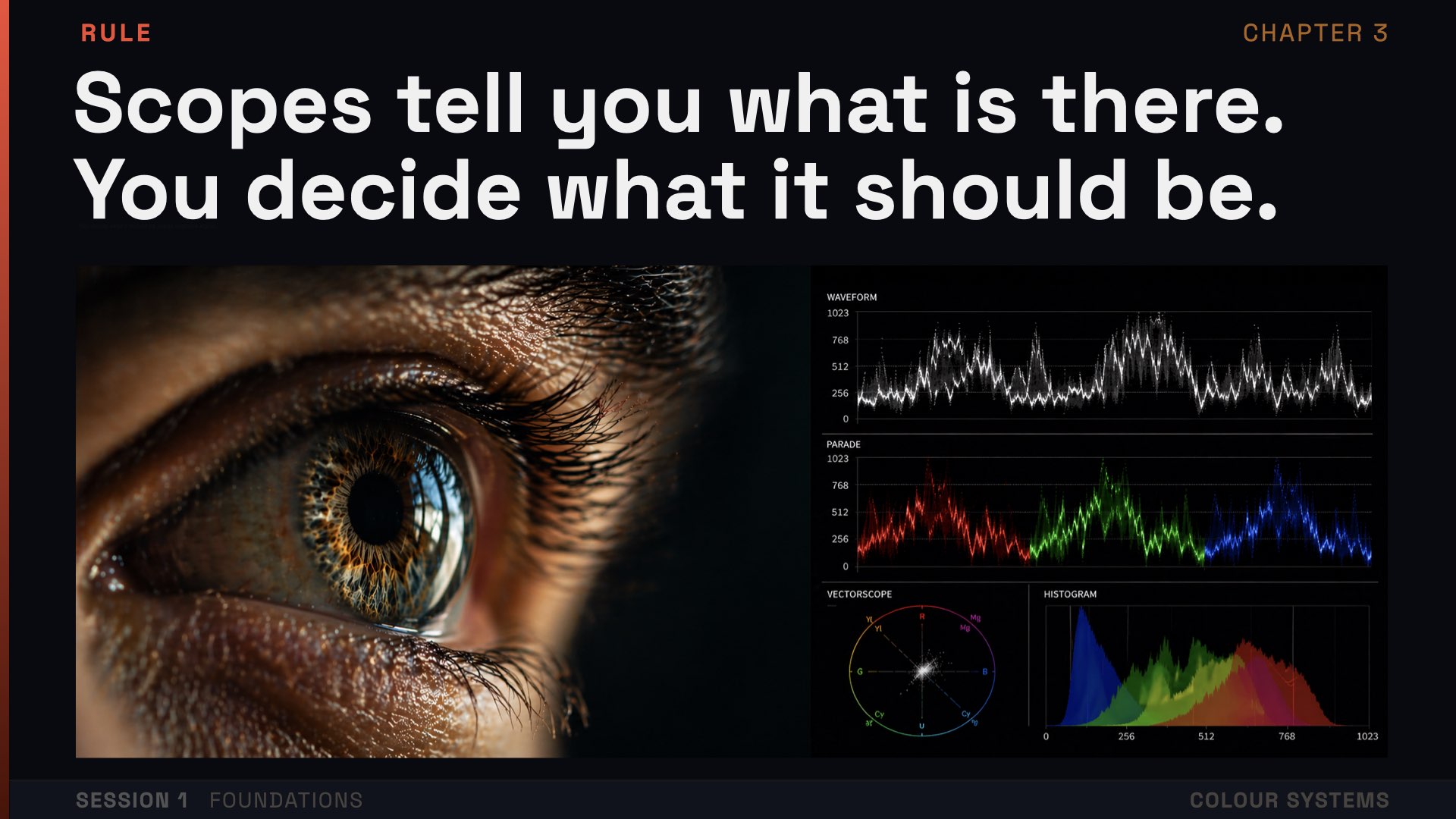
The first session covers the Foundations: colour management, balance before look, scopes, colour wheels, curves, memory colours, and skin tones.
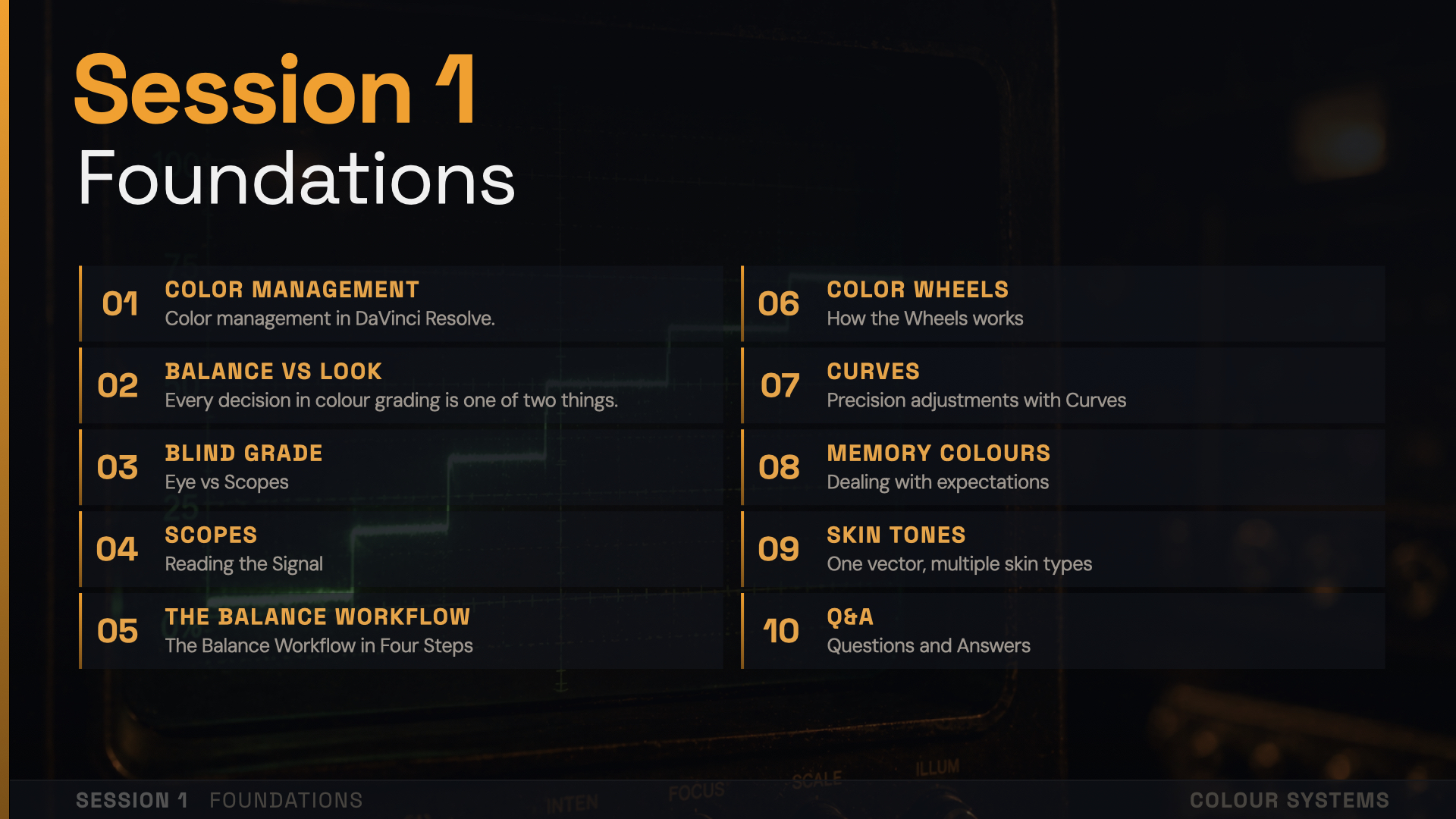
Because the first Color Systems session is the most developed, it is also the clearest example of how practical the material already is.
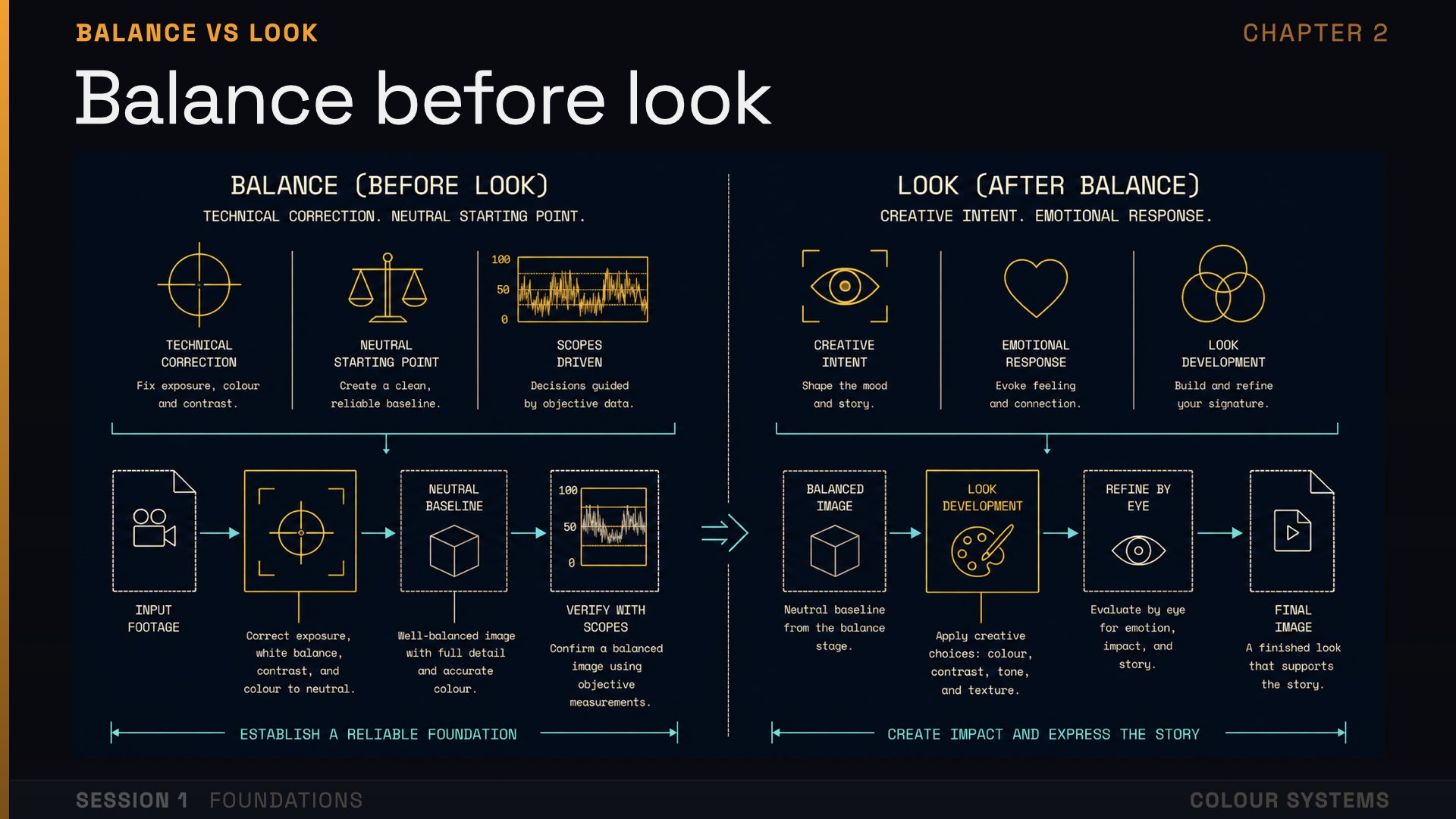
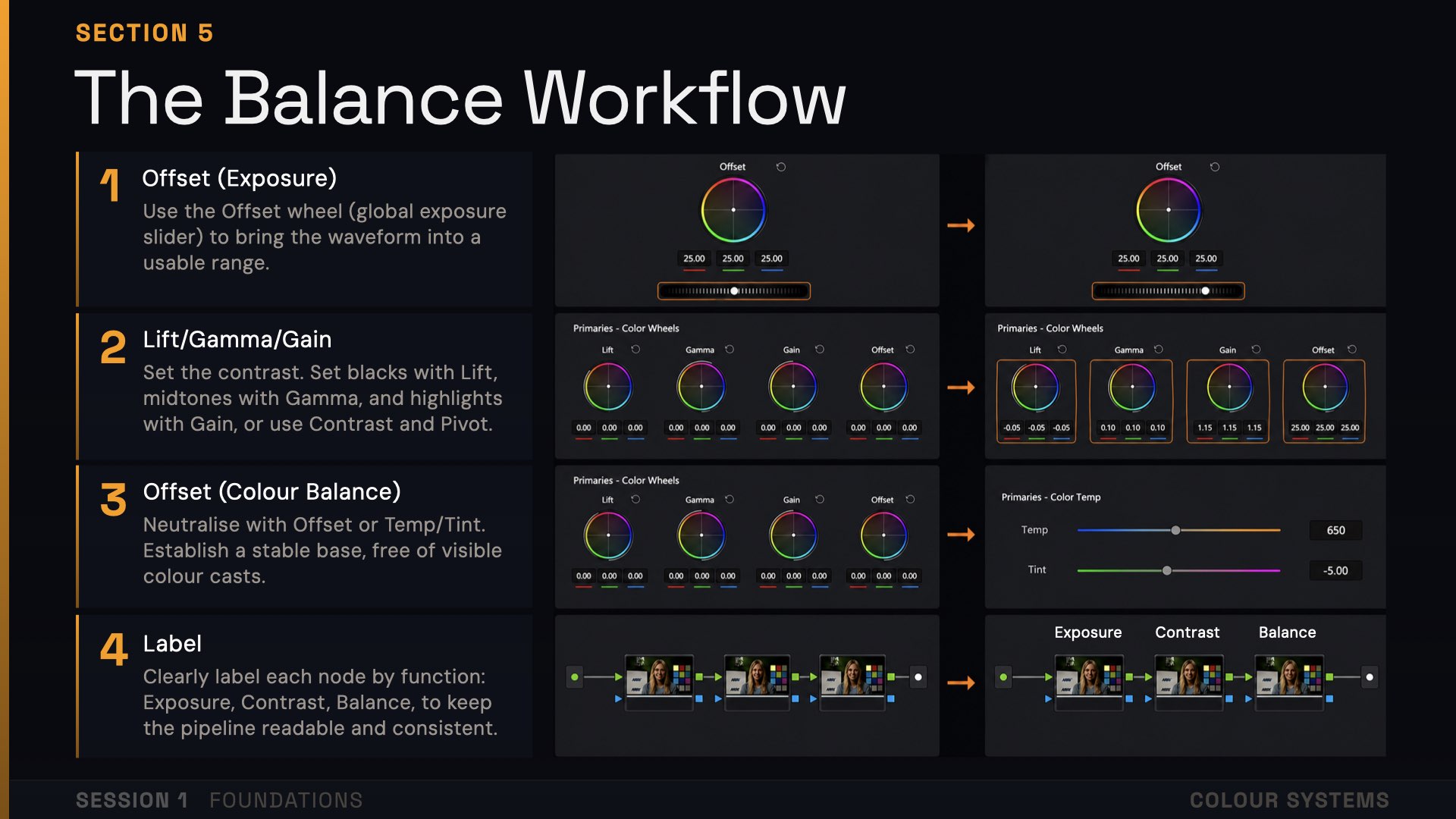
The second builds toward matching and continuity: choosing a hero shot, working with references, building a primary node structure, and handling the problem cases that appear when real footage refuses to behave neatly.
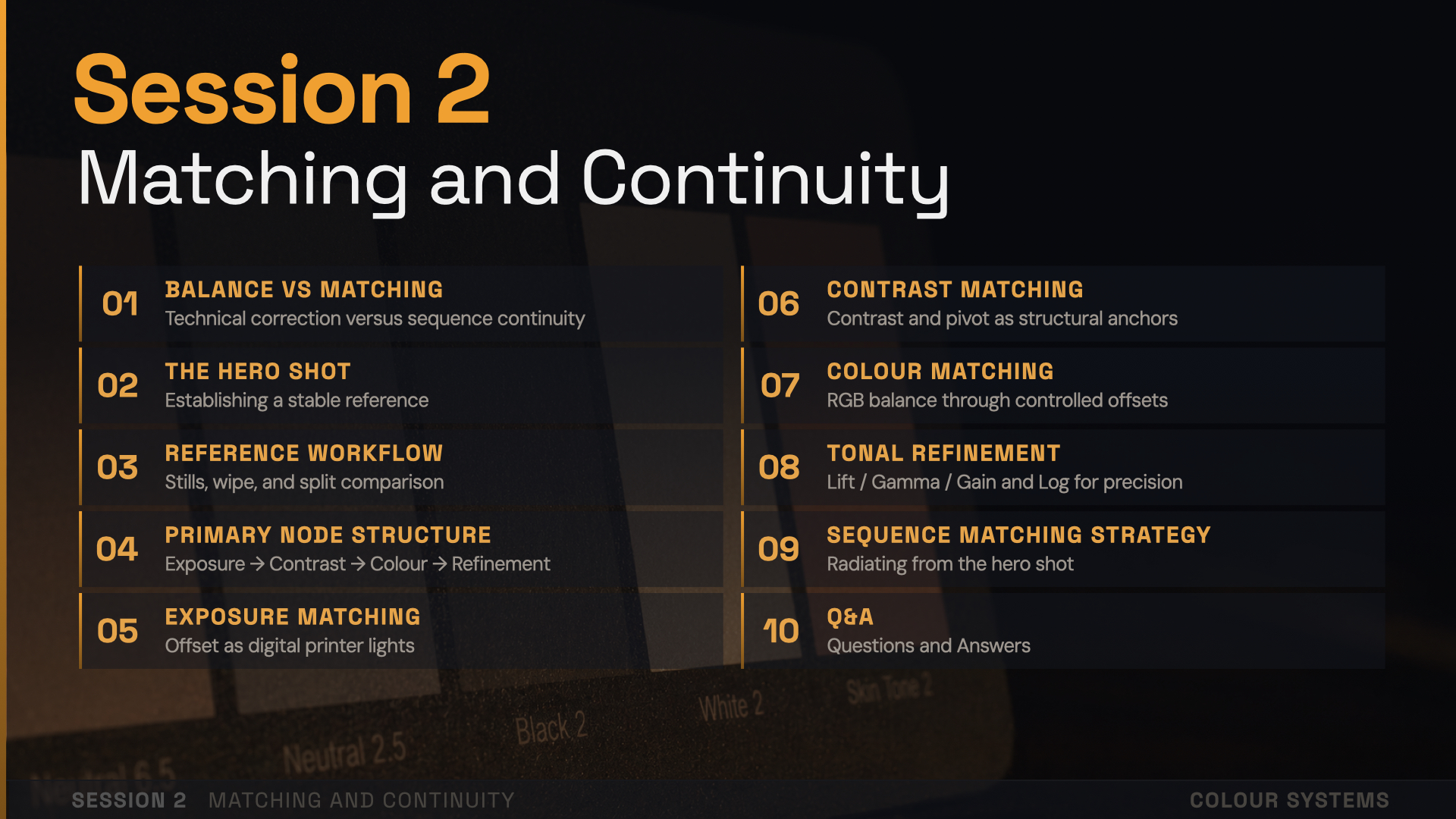
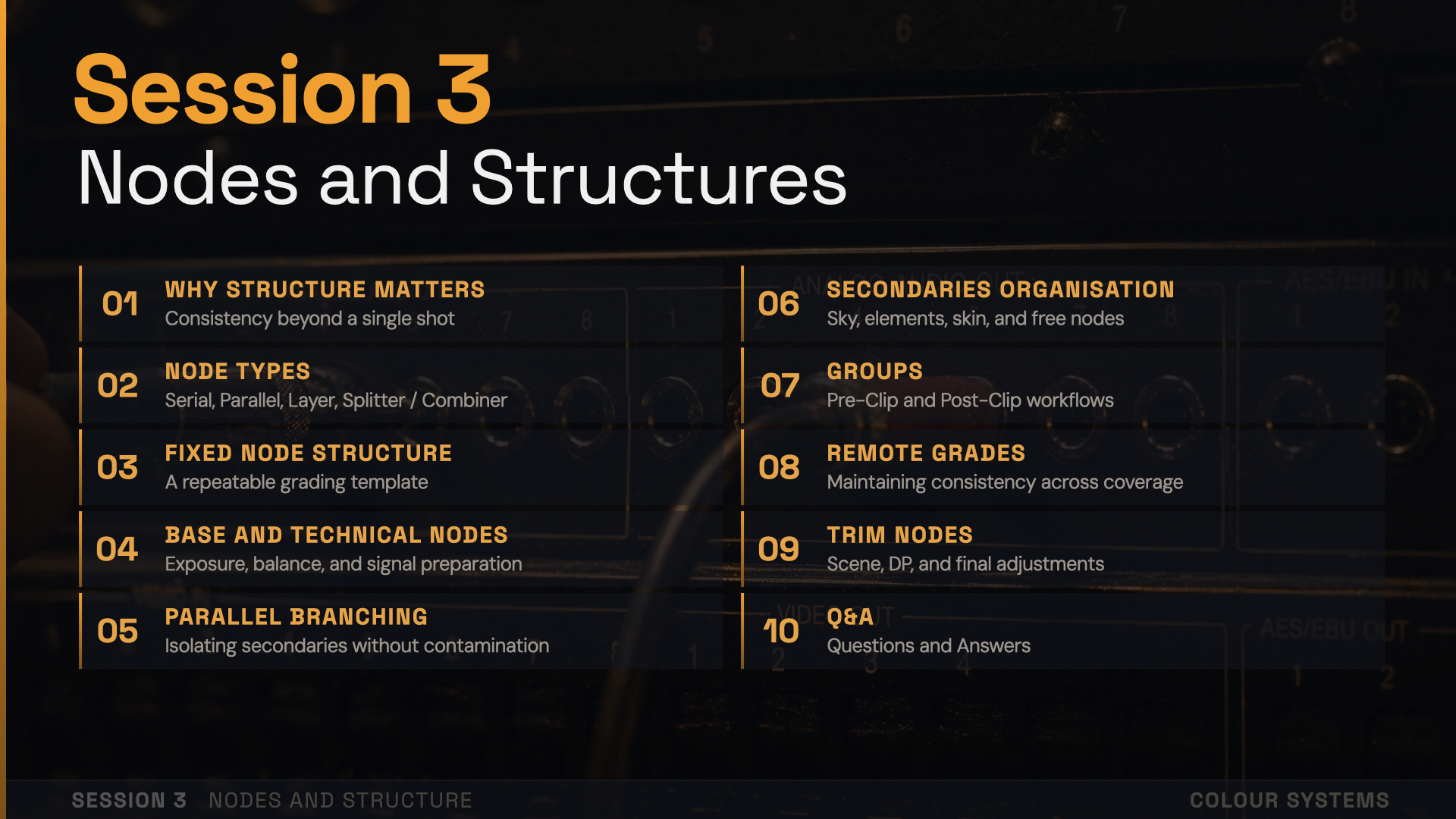
The third scales up: node types, fixed structures, parallel branches, secondaries, groups, remote grades, trim nodes, and the kind of repeatable systems that hold across a whole sequence rather than a single hero frame.
This course is also built around direct practice, not demonstration alone.
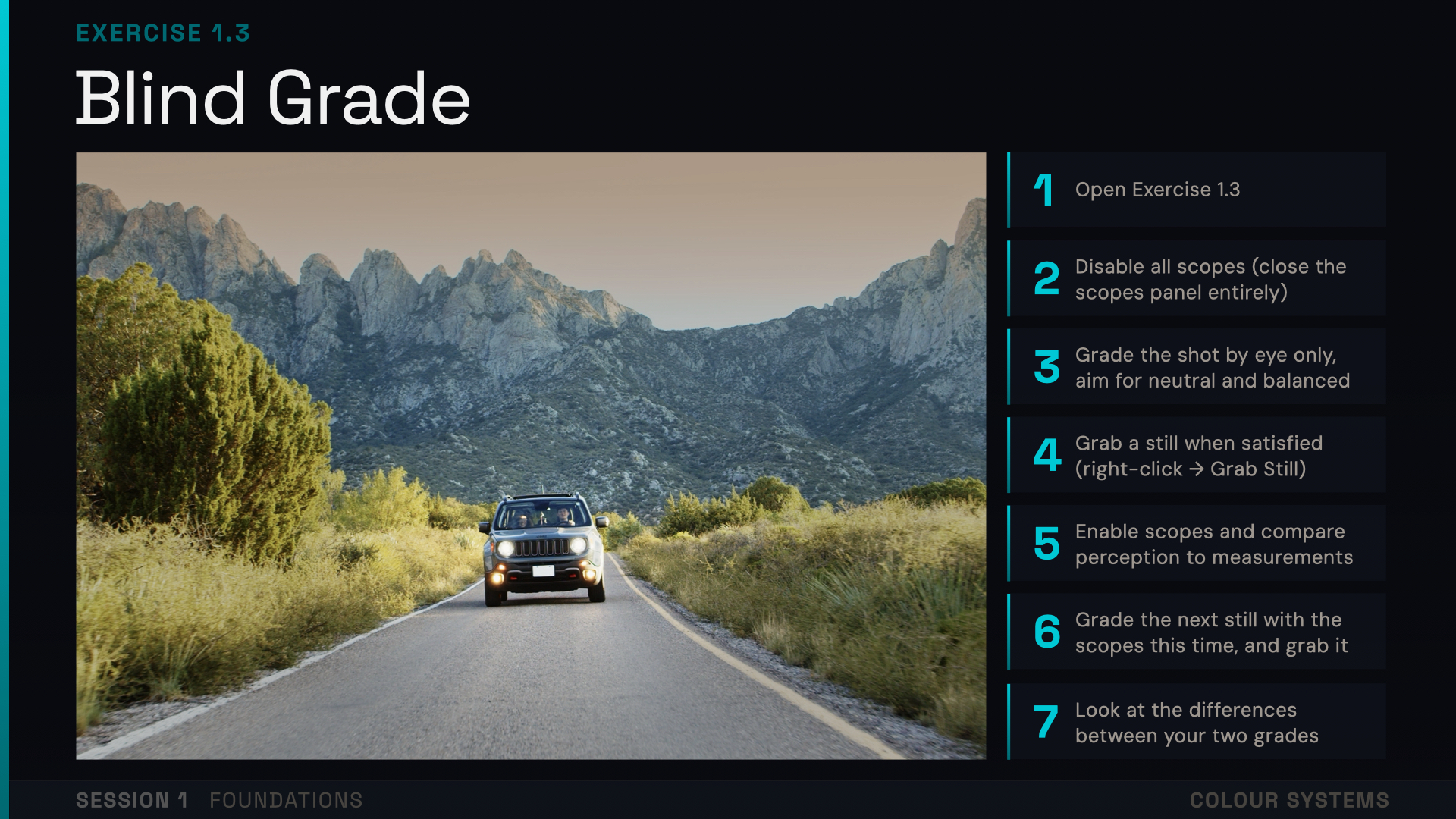
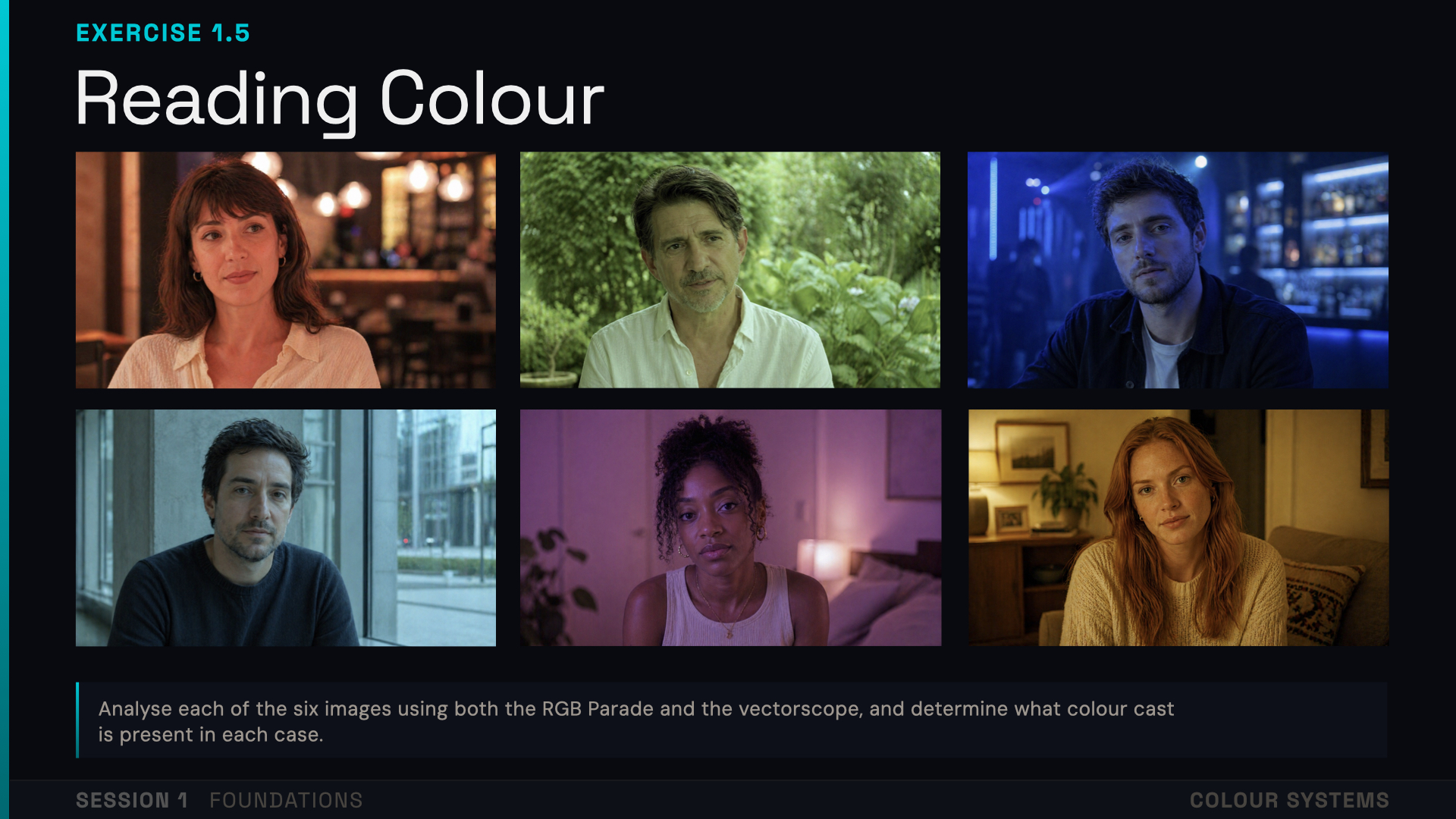
Every topic is reinforced with hands-on exercises, so students are not just absorbing concepts in the abstract; they are testing perception, reading evidence, comparing decisions, and learning how the tools behave under real grading conditions.
They are different courses because they solve different problems. Signal to Noise teaches the behaviour of the image as data. Color Systems teaches the behaviour of the image as a grade.
But they belong together. Technical literacy without aesthetic judgement becomes rigid. Aesthetic judgement without technical literacy becomes fragile.
Teaching tools, not easy solutions
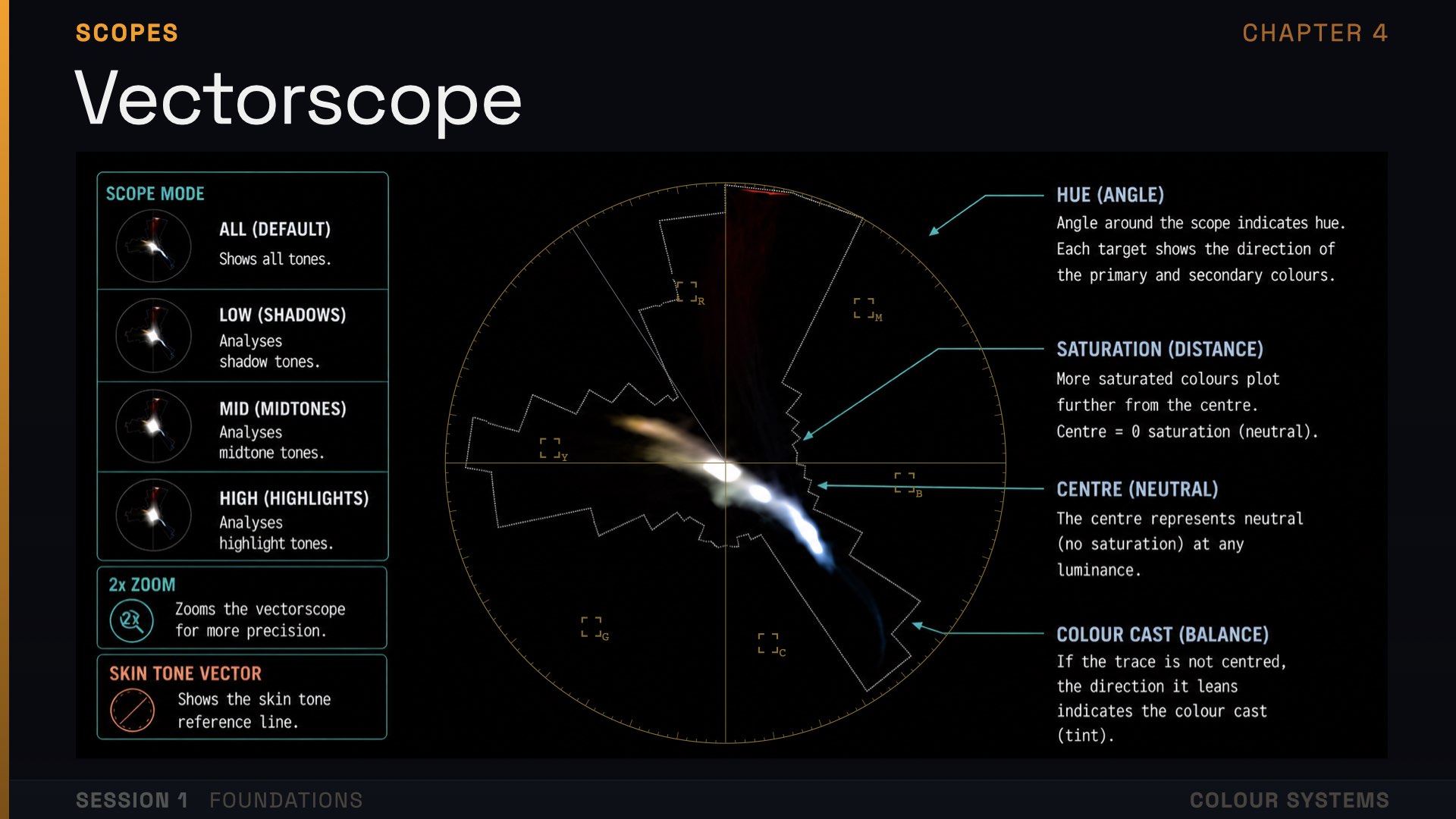
I want students to understand scopes not as intimidating graphs, but as evidence. Colour management not as a checkbox, but as infrastructure: something that determines what every other decision means. Codecs, transforms, display standards, and node structure as practical tools for thinking, not as specialist knowledge reserved for engineers.
The goal is not to make grading more complicated. It is to make it less mysterious.
When someone understands the why, they can adapt. They can look at unfamiliar footage and build a path through it. They can make aesthetic choices with technical awareness. They can defend a decision, revise it clearly, or abandon it for a better one, without losing their footing.
That is much more durable than a recipe. Tutorials become obsolete when software updates. Recipes fail when footage changes. A mental model of how images actually behave, how signal moves, degrades, transforms, and is shaped, stays useful across cameras, platforms, pipelines, and tools that have not been invented yet.
A better kind of confidence
Good training should leave people with better questions.
Not just “which button do I press?”, but:
- What is the image actually asking for?
- Where is the signal strong, and where is it at risk?
- Am I correcting a technical problem or making a creative choice?
- Is this transform happening in the right place in the pipeline?
- What will this decision do downstream?
- Can I explain why I am making it?
That last question is the centre of it.
If you can explain why, you are no longer just operating software. You are making decisions with intention. That shift, from reaction to reasoning, is what separates a colorist who can handle one good shot from one who can grade a whole project reliably, under pressure, with footage they have never seen before.
The future of post-production will contain more automation, more abstraction, and more generative tools. The people who understand the logic underneath those tools will be the ones who can use them without being led by them.
That is what I want to pass on.
Signal to Noise and Color Systems are currently in development. If you are interested in one-to-one tutoring based on this material, or want to be notified when the courses open, get in touch.